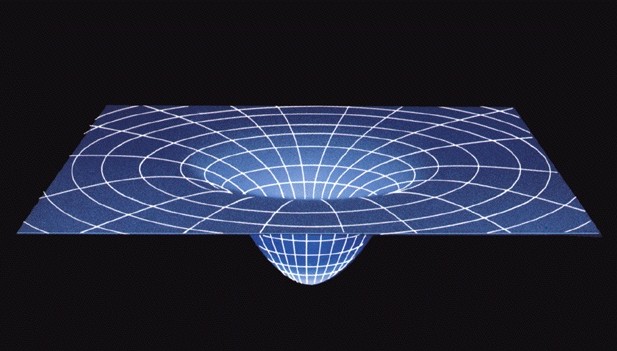
The invention or discover of non-Euclidean geometry really messed up philosophers’ claims to apriori knowledge. For centuries, philosophers were sure that claims like, “The angles of a triangle are equal to two right angles” are paradigmatically clear examples of apriori truths. But these claims are false in any geometry other than Euclid’s, as has been known from roughly 1818 onward. Worse yet, physicists regard non-Euclidean geometry as (at the very least) the most useful model for physical space. So Euclidean geometry turns out to be, on this view, not only not necessarily, but not even actually true. Real triangles, the kind obtaining among points in real space, have angles summing to more or less than two right angles, depending on where they are and what’s in the neighborhood.
Kant claimed that space is a form we impose upon our experience, and as he had no inkling of non-Euclidean geometry, he of course believed that truths about Euclidean space are apriori synthetic. So what is a good Kantian to do in the light of non-Euclidean geometry? One easy (but dead-end) option is (A) to reign in Kant’s claims and say that he wasn’t talking about the fancy experience physicists describe, but only ordinary, everyday human experience, where Euclidean geometry still holds. But that clearly does not capture Kant’s intent, and turns his epistemology into – what? – a chronicle of the structures of casual experience? An account of untutored beliefs about geometry?
A slightly better option is (B) to simply upgrade Kant to current geometrical knowledge, but here matters get tricky. But from what I understand, there is disagreement among philosophers of physics about how to regard the nature of the geometry of space. Realists believe there is a fact about whether space is truly Euclidean or non-Euclidean. Others, following Poincare, think the geometry of space is conventional: we can choose to regard space as Euclidean, and make certain changes in our assumptions about how objects change shapes in certain situations, or we can choose to regard space as non-Euclidean, and as non-Euclidean in this way or in that way, and then change other assumptions. So if we want to simply upgrade Kant, we have a variety of packages to choose from; and the very existence of that choice makes the move to upgrade Kant troubling, since the whole idea of the apriori synthetic is to capture what is necessary for the possibility of experience.
One point to think about is a claim Frege made early on: that space, and geometry, requires some kind of intuition. In cheap words, space is essentially spacey. Geometers these days don’t really use or need diagrams, as their work is mainly done through equations and nonspatial models. Frege would say they have stopped doing real geometry. If we follow Frege, we could say that Euclidean geometry is still necessary for us when we are dealing with true space, the kind of structure we can represent to ourselves as space. When we try to represent to ourselves non-Euclidean geometry, we have to use three-dimensional Euclidean space in order to exhibit some curved two-dimensional surface which serves as a metaphor for what’s going on in a non-Euclidean space (see diagram). So we are stuck with Euclidean space if we ever want to represent space in a spacelike way to ourselves. Frege would say that this is significant: Kant was right to insist that space, true space, is Euclidean, though we have found all kinds of nonspatial (and strictly nongeometrical) ways to describe other possibilities. This is a dressed-up variant of the (A) strategy.
A second point to consider is whether there are still some features or elements binding together our models of both Euclidean and non-Euclidean spaces. I trust that contemporary geometers are still constrained in various ways as they assemble different kinds of space, and those ways are not mere consistency; in other words, there is still some spacey-ness underlying all different possible models of space; there is something in virtue of which these models count as spatial models. (I could be wrong about this.) If this is so, then those more fundamental constraints might be candidates for the synthetic apriori.


 Huenemanniac
Leave a comment