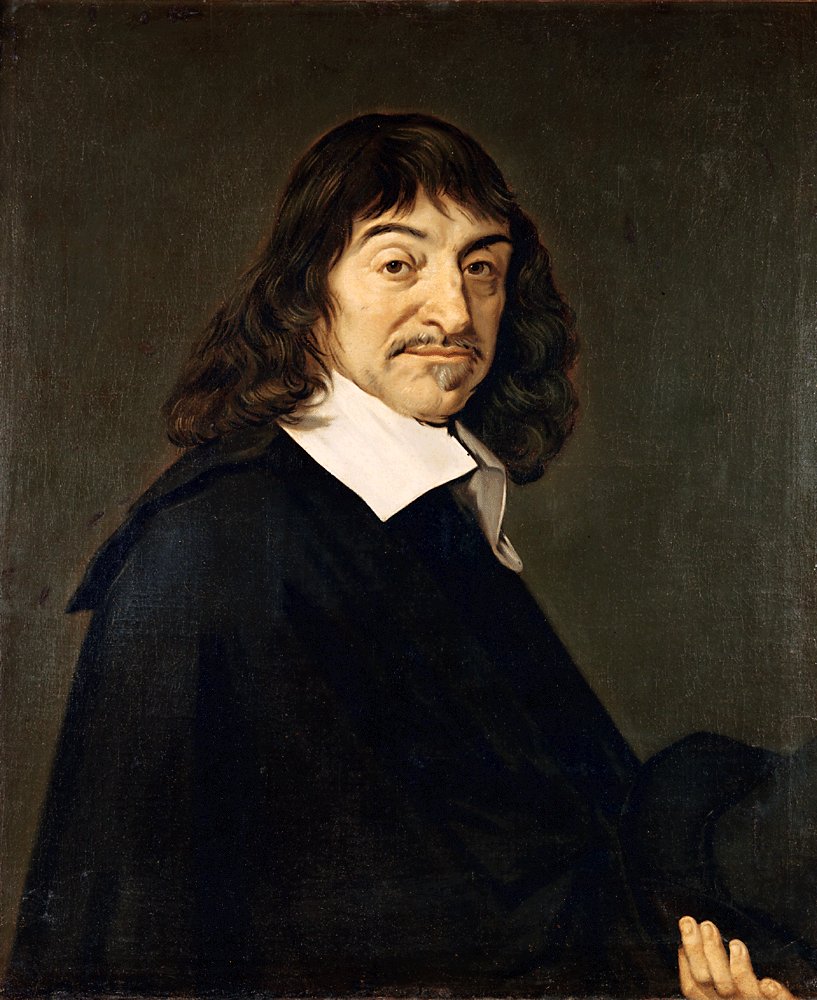
 There is no text more commonly read in philosophy courses than Descartes’s Meditations on First Philosophy. This is astonishing, given that the work was written well over three centuries ago. To some extent, to be sure, it is so commonly assigned simply because it is so commonly assigned; that is, it is hard to imagine an undergraduate escaping from a program in philosophy without having read the work at least once – because every program assigns it. This is a true perpetual motion machine.
But the book is a natural choice to assign to undergraduates because of its approach. Descartes pretends to cast aside all the crap he learned in high school and figure out for himself what he should believe. This is exactly how we would like to think of undergraduates, leaving the home environment and state-mandated education for the first time and venturing out on their own to discover the world, building their own minds in the process. Descartes asks his readers to doubt everything, and see what remains as indubitable; and he builds a new world upon a new foundation. And that is the ideal of university education – and yes, yes, it is an ideal rarely met, and one that is always under attack by those who would like to see the university as training for the workplace rather than an enterprise in soul-building. (Newsflash: it is going to be soul-building in any event, and our only choice is in deciding what sorts of souls are going to be built.)
But why did Descartes write this work? Was he trying to write a bestselling textbook for university students? Was he excited about his own efforts at soul-building, and intent upon sharing his success with the world? He had each of these motivations, in some sense. He certainly was excited and wanted to be influential. But his chief motivation was to offer to a broad, reading audience in his day a new structure for their beliefs. For any reader keeping score, not much has changed by the end of his work – he starts out believing in God, a soul, and the physical world – throws this all into doubt – and ends up believing once again in God, a soul, and the physical world. What has changed is the arrangement of these beliefs, and what they are based on: Descartes’s world has gained a different structure upon different foundations. His aim in the Meditations is to convince his readers that they can still believe in all the important things they want to believe in, even if they accept the radical revolution in physics and metaphysics that was brewing in the 17th century. It is just that they will have to re-arrange their beliefs a bit.
The view that was being overturned in the 17th-century had its roots in Aristotle’s philosophy. According to this view, the main players in the world are substances, or bundles of matter that have certain natures, and behave in ways according to those natures. Every substance tries to go about its own natural business, but inevitably each ends up getting in another’s way, sometimes in ways we like and other times in ways we don’t like – and thus the world. Descartes and his comrades believed that the content-rich “natures” of substances could be replaced by more austere, geometrical entities. Basically, the new philosophers asked us to replace a blooming, buzzing botanical garden of metaphysical natures, forms essences, modes, and qualities with a sculpture park designed by Mies van der Rohe. It must have looked like a very poor exchange indeed, giving up an extraordinarily rich set of explanatory powers for a set of meager promissory notes that did not encourage much confidence. The philosophers that Descartes was writing to worried about the cost of swapping out one operating system for another: how would the change affect our beliefs in God and in the soul, as well as our commonsensical ways of explaining nature?
So Descartes wrote the Meditations as way of saying, “See? You can still have strong arguments for the existence of God, and for believing in the existence of a soul; and you can have excellent new strategies for explaining why the physical world behaves as it does.” It was meant as a persuasive and reassuring work, a work that demonstrated that you could still do everything you wanted in the new operating system. (I am not sure whether to cast Descartes as Mac or PC; his system was slick, new, radical, and hard to use – so maybe Linux?) His arguments, as countless undergraduates have demonstrated, are not faultless. But that’s okay; they are good enough for Descartes’s primary purpose, which was to show that conversion to the new philosophy does not require giving up on the sorts of arguments valued by philosophers of the time. His overall rhetorical strategy is to demonstrate that from a completely unbiased starting point – one that is achieved through radical skepticism, doubting everything you think you know – it is perfectly possible to end up inhabiting the new system. It was not as foreign as it may have seemed.
Seen in this way, Descartes’s Meditations really is a work that is stuck in a particular historical context. It is safe to say that few readers today are seeking to be reassured that they can give up their Aristotelian metaphysics for a geometrical world view. This makes it all the more surprising that the Meditations is so frequently read today. But the work, of course, has been repurposed: once designed to serve one polemical purpose, it now serves another. Once meant to ease the transition from old to new philosophies, it now eases the transition from pre-philosophical to philosophical thought. And, as one would expect, it succeeds only partway in this new purpose. Students really do find themselves challenged by Descartes’s skeptical doubts – but they are uniformly unimpressed by Descartes’s own solutions. No one buys his arguments. The overall effect, I am afraid, is a general mistrust of philosophical arguments. Students come away thinking that philosophers are much better at raising troublesome, skeptical questions than they are at providing good solutions. Every argument is bound to fail. And this in turn engenders a measure of misology, or a distrust of reason, at least as it applies to philosophical matters. Philosophical theses come to be viewed as indemonstrable matters of taste.
This is unfortunate for our students – and also, by the way, quite unfair to Descartes. Imagine walking into a computer shop, exploring whether to change to a new system. You worry about the new system’s ability to generate spreadsheets. A helpful assistant demonstrates how to set up a short, tidy spreadsheet in the new system. But you reject the demonstration entirely, since you need have no need for the spreadsheet example you have been shown. “No fair!” the assistant pleads. “I was just showing that you could do this sort of thing!” And this is basically what Descartes wants to tell the undergraduate who has just savaged his argument for God’s existence in the third meditation. The student has missed the central point that Descartes’s operating system supplies arguments for God’s existence just as well as Aristotle’s old operating system. But today’s student, of course, has little reason to be impressed by this feature. And that’s why the way that Descartes’s Meditations is usually taught – namely, as a non-polemical, disinterested research into what is known with certainty – ends up being quite unfair to him.
I do not mean to suggest that Descartes was only trying to show that philosophers could still have good arguments within his new operating system. He believed his arguments were truly compelling – and they are indeed much better than our undergraduates take them to be. But his main aim was to get philosophers talking about his arguments, while making use of his new system – that is, he wanted fellow philosophers to try working within his system and find out for themselves that abandoning Aristotle did not mean abandoning philosophy. It is for this reason that he sent out copies of the Meditations to several influential figures, of diverse backgrounds, and published their objections alongside his replies. The resulting publication was itself a demonstration that this new operating system was sufficient for fruitful and intense philosophical discussion – like getting en entity like UPS to use an open-source operating system.
But all this puts teachers of historical philosophical texts in a bit of a quandary. Taking proper measure of an historical work’s context might make it less gripping to modern students (unless they are blessed with geekiness over history). But re-purposing historical works is unfair to those works and leads often to unintended consequences. So should teachers simply leave history alone, and let the dead rest? Or should they plunge ahead anyway, believing that the good in confronting great texts outweighs any mistaken judgments that are encouraged along the way? What is the best way to read/teach this kind of book?
Though I do end up worrying over this question from time to time, in the end I think it is a false dilemma. None of the foregoing concerns should be out of place in an undergraduate curriculum. That is, we can imagine a fantastic class on Descartes’s Meditations in which we read the texts with our own concerns and questions; find problems in the text; introduce more historical circumstance to reorient our reading, and come to a better understanding of the text; and then see whether we have learned any global lessons about history, philosophy, writing, and reading as a result. In the case of the Meditations, we will probably discover that no conceptual revolution is without its costs; that even an antiquated system like scholastic metaphysics had some very real advantages; that revolutions in thinking aren’t “proven” by experiment, but involve a willingness to conceptualize our experience in new ways; and – perhaps most important of all – there is always a deeper story to be told. Books aren’t repositories of truth, but bits of evidence in a crime scene, and it’s up to us to figure out whodunnit and why, and even: so what?


 Huenemanniac
Leave a comment