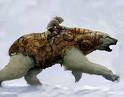
 I recently finished the trilogy by Philip Pullman, “His Dark Materials.” It is a set of books aimed at young adults, but when I saw the film of “The Golden Compass,” I found the ideas appealing enough to give the books a try. I was not disappointed.
Most of the action takes place in a parallel universe, in which people’s souls (or daemons) walk around outside them in animal form. The relationship between a human and its daemon is complex: they need to be in close spatial proximity in order for both to survive, and they sense one another’s emotions, but they have separate consciousnesses and have conversations with one another. If the psychic link between the two is severed, the daemon dies and the human becomes listless. We learn later that when a human is killed, its daemon turns evaporates into the cosmos while the human’s own spirit is sent to the land of the dead.
We also learn that some stuff called “Dust” permeates this world, and is somehow linked to consciousness, intelligence, and creativity. Humans produce it when they think, create, and initiate. An organization known as the Church is convinced that Dust is in fact Original Sin, and is reacting against it with fear and rage. Dust dates back to the first fall in Eden, it seems, or the emergence of consciousness in early hominids. Also around that time there was a rebellion of angels against God (or the Authority), and it seems that at least some angels are plotting a second revolution.
The Authority was once an angel, but somehow ascended to greater power and ruled the universe. But he grew old, and delegated most of his authority to a mean angel, known as Metatron. By the time we meet the Authority, he’s a benign, senile old fool, and he dies without much fanfare.
(Side note: I now understand why Zarathustra claims “God is dead” rather than that God doesn’t exist. Look at history: in the early days, if you read the Bible, God is active and effective. Later, he acts only through prophets and angels. By the time of the Reformation, he’s well-nigh invisible. Zarathustra is simply confirming what everybody should have suspected: by now, surely, the old man must be dead. We haven’t heard from him in millennia.)
Our world, and a few other worlds, get caught up in the drama as well, because a boy named Will (from our own world) comes into possession of the Subtle Knife, which allows its wielder to cut passage from one world to another. The problem is that whenever this happens, some Dust (known in our world as “dark matter”) starts spilling out through the cut. So Dust, overall, is declining in quantity, and worlds start falling apart, since somehow they need intelligence, perhaps as a human in Lyra’s world needs a daemon. Lyra and Will become second-generation Adam and Eve, though it is their job to preserve the Dust and frustrate the Church’s objectives.
There is fantastic imagery throughout: iron-clad polar bears, zeppelins, witches, tiny warriors riding dragonflies, and so on. It’s a very compelling story, and I’d love to be in a group exploring its many layers of metaphor.


 Huenemanniac
Leave a comment