Huenemanniac

Getting distracted by ideas


Norm Jones, friend and scholar

I spent some time this afternoon with a book by my friend Norm Jones, who was taken from the world this morning after struggling against cancer. There is so much to say about Norm: his great stature as a historian of early modern England, his broad and deep curiosity about everything, his inimitable manner of giving accurate and folksy explanations for even complicated phenomena, and his big heart that prompted him to make sure everyone felt included in the discussion.

So I went over to the library and picked up one of his books.
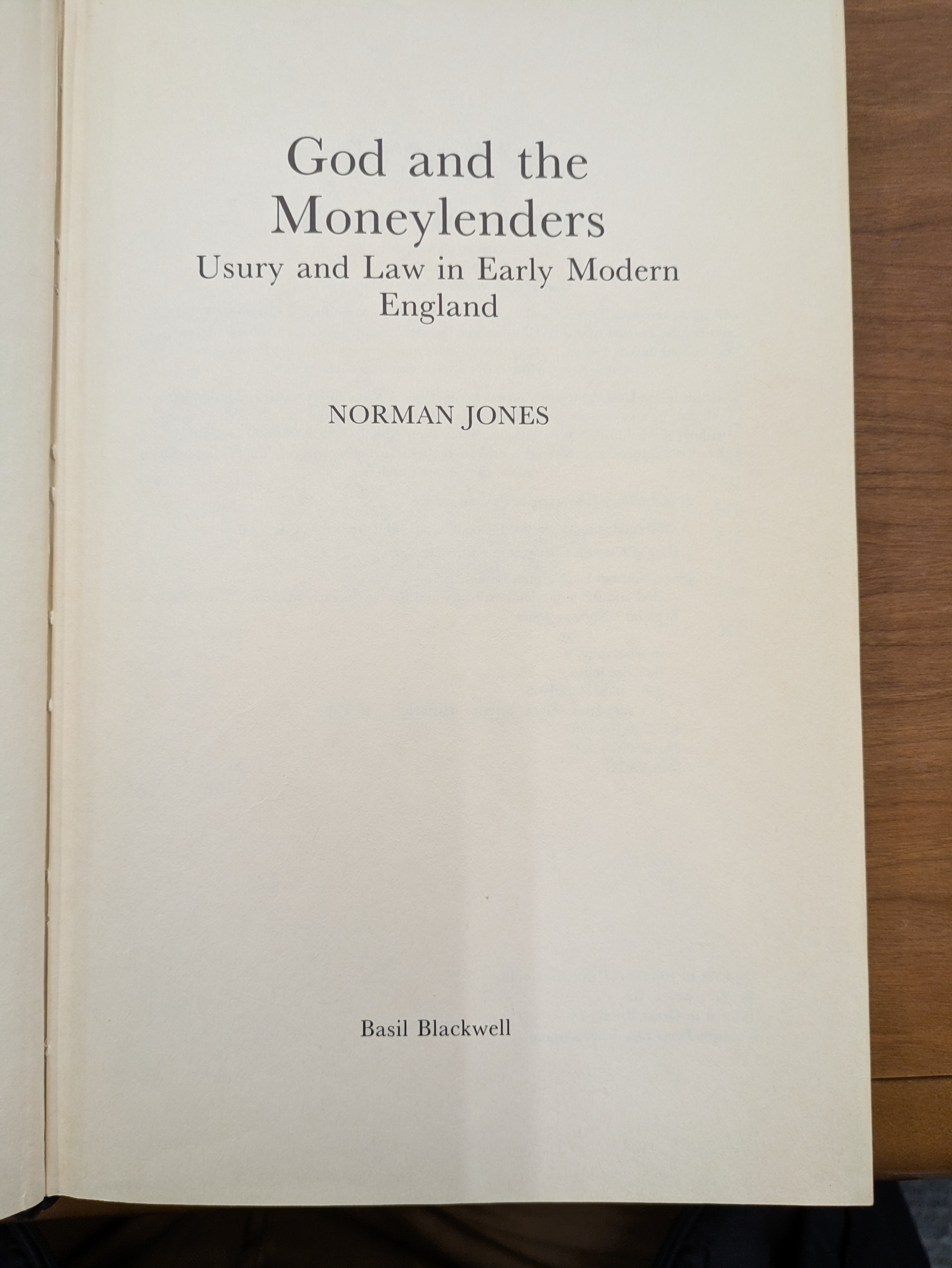
And the topic is fascinating. We have, on the one hand, the fact that the Lord has very clearly forbidden charging any substantial interest on loans (usury). For example (and there are dozens, similar in tone, in both testaments): “Thou shalt not lend upon usury to thy brother; usury of money, usury of victuals, usury of any thing that is lent upon usury” (Deuteronomy 23:19). We have, on the other hand, the fact that one can make A LOT of money by doing so. So, something has to give, and (predictably) the Lord’s commandment has been made softer. This was a very live issue in England in the 1500s, especially as Protestants found a need to reconcile their financial appetites with their faith.

So Norm’s book is about this negotiation, especially as it took place through legalistic channels. One contributor (Walter Howse, it seems) to the discussion drew up what practices a lender must follow in order to not be guilty of usury as a sin:
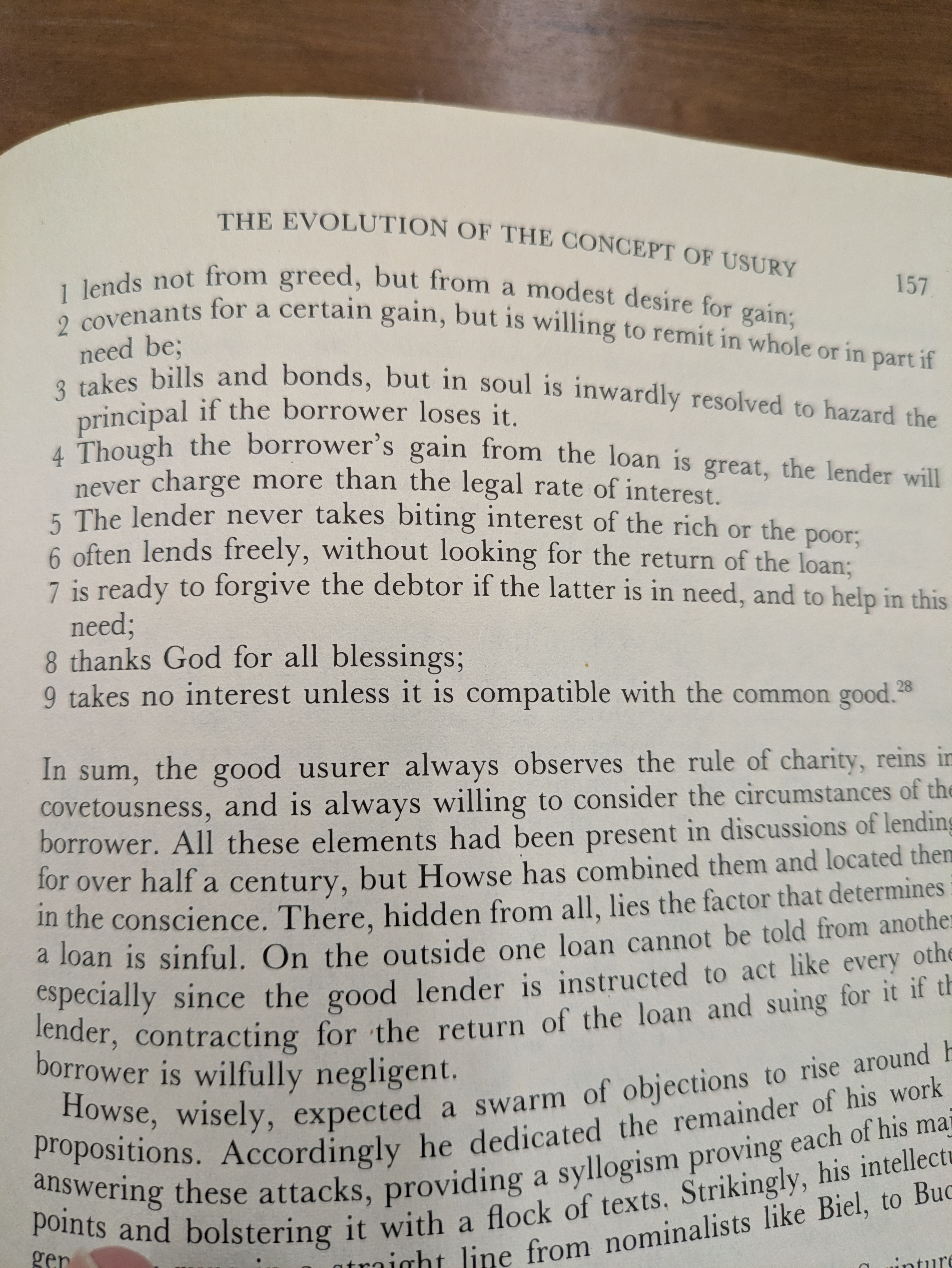
In other words, you may charge interest, but only if you do so humanely. Alas, even this concession to the Lord seems to have been too much, as the most casual student of economics knows.

A friend’s book is no substitute for the friend, of course. But the conditions of our mortal existence often allow for no more than this.


5 responses to “Norm Jones, friend and scholar”

  1. The parable of the unforgiving servant (Mat18:21-35) is instructive. Many years ago my biz-partner and I bought a machine which was to be paid for by consumption of materials. Well, client demand never arose to adequate levels; and several years later the manufacturer mercifully wrote off the deal. We felt hugely grateful.

    Liked by 1 person

  2. Further thoughts. Charlie, you said: A friend’s book is no substitute for the friend, of course. But the conditions of our mortal existence often allow for no more than this.

    “The Friend” (the paraclete, the “holy ghost” – see John 14:26, etc) has also left us a book of books. And Johnny Cash has left us a song: “The Soul of Man Never Dies”. Many have sung this across the ages, before it was penned by Cash. The body is perpetually inviting us to consider whether we are comfortable (“the comforter” again, the paraclete) in our own skin — or if we might be better comforted as united in One Thing? (see Deut 6:4, “ehad”: One, > as one grape participates in a bunch.)

    Like

    1. Thanks for the replies, Eric! I’m not sure if you are referencing the sort of life we have in the minds and lives of others (which continues after we die), or a kind of metaphysical unity in which we all participate, and in which individuality disappears, and so an individual’s death does not really change things. (Or something else?)

      Like

      1. My present sense is that we are all part of a unitary organism “headed” by a very Patient Teacher having faith in each of His/Her children. But I claim a right to revise my position as experience unfolds! (Waves on the sea have an identity in the logs of oceanographers. After they crash on a shore, they are subsumed into the One sea, leaving us to scratch our heads, asking: ¿What is identity?) ~eric.

        Liked by 1 person

  3. I do understand the appeal of Neoplatonism!

    Like

Leave a reply to Huenemann Cancel reply